
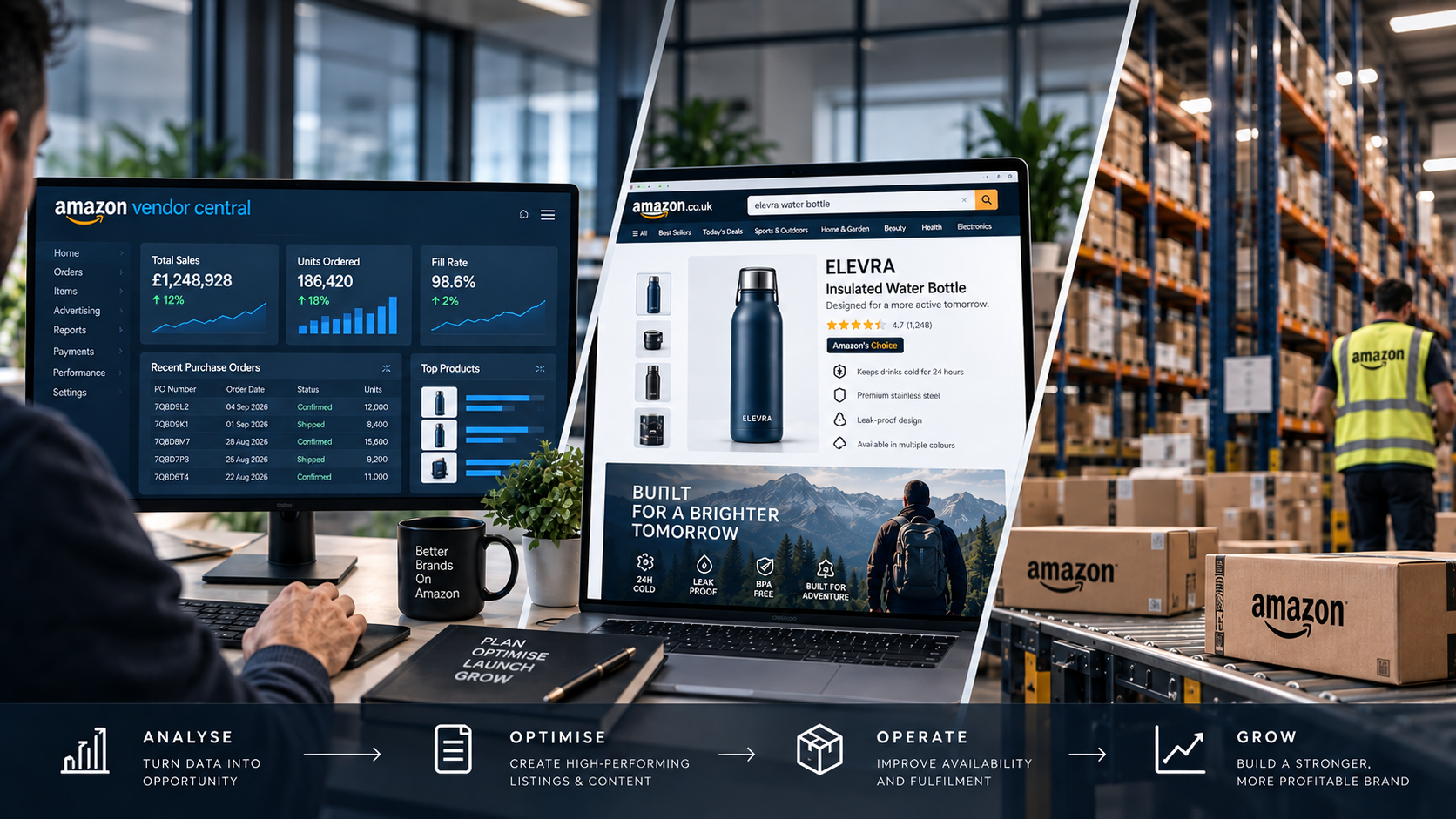
What is Amazon Vendor Central management?
And how can a specialist agency help?
What is Amazon Vendor Central management?
For many established brands, Amazon has become too important to treat as simply another e-commerce marketplace.
When you operate through Amazon Vendor Central, Amazon is effectively one of your wholesale customers. Your business supplies products directly to Amazon, Amazon purchases and holds the stock, and Amazon then sells those products to consumers.
That relationship can create significant opportunities for brands, but it also introduces considerable complexity.
Purchase orders, catalogue management, product availability, forecasting, shortages, deductions, advertising, product content, Brand Registry and profitability all need ongoing attention.
That is where Amazon Vendor Central management comes in.
A specialist Vendor Central management partner can act as an extension of your internal team, managing both the day-to-day requirements of supplying Amazon and the longer-term strategy needed to grow the channel profitably.
What is Amazon Vendor Central?
Amazon Vendor Central is the platform used by manufacturers, distributors and brands that supply products directly to Amazon.
Rather than selling individual products directly to consumers, a Vendor typically receives purchase orders from Amazon, supplies the requested inventory and invoices Amazon for those goods. Amazon then becomes the retailer.
For suitable brands, this provides access to the scale and infrastructure of one of the world’s largest retailers. But becoming an Amazon Vendor does not automatically translate into a successful Amazon business.
One of the biggest mistakes brands can make is assuming that because Amazon is purchasing their products, Amazon will take care of everything else.
Your catalogue, content, availability, advertising, commercial performance and operational processes all influence the success of the account.
What does Amazon Vendor Central management involve?
Good Vendor Central management covers much more than logging into the platform and processing purchase orders.
We look at an Amazon Vendor account as an interconnected commercial channel. If Amazon is not ordering enough stock, sales can suffer. If product information is poor, conversion can suffer. If listings are not optimised for relevant searches, customers may never find the products in the first place.
If advertising is not managed properly, spend can increase without generating sufficient incremental sales. And if deductions, shortages or operational issues are not monitored, a seemingly successful Amazon account can become considerably less profitable than the headline revenue suggests.
Effective Vendor Central management therefore needs to consider the entire picture.
1. Vendor Central account management
At its most fundamental level, somebody needs to take ownership of the account.
That includes monitoring Vendor Central, dealing with cases and account issues, managing catalogue changes, reviewing performance and identifying problems before they become larger commercial issues.
For businesses without a dedicated Amazon team, responsibility for Vendor Central often becomes fragmented across e-commerce, sales, finance, marketing and operations. Everyone may be involved, but nobody truly owns Amazon.
We can operate as an extension of your business, providing dedicated Amazon Vendor expertise while working alongside the people already responsible for your brand, operations and commercial strategy.
2. Catalogue and product listing management
Your Amazon catalogue is the foundation of your presence on the platform.
Product titles, bullet points, descriptions, search terms, attributes, images and other catalogue information all influence how products are presented to customers.
Duplicate ASINs, incorrect attributes, variation problems, outdated images, incorrect product information and conflicting catalogue contributions can all affect how a product appears.
Our Vendor Central management approach includes ongoing catalogue management as well as the optimisation of existing products. We do not simply upload products and move on; we continually look for opportunities to improve visibility, accuracy and conversion potential.
3. Amazon listing optimisation and SEO
A strong product does not guarantee a strong Amazon listing. Customers need to be able to find the product, understand it and have enough confidence to buy it.
That requires both search optimisation and conversion optimisation.
We research how customers search within the relevant category and use those insights to improve titles, bullet points, product descriptions, attributes and other listing content.
Amazon SEO should not be treated as an exercise in simply inserting keywords. The content still needs to communicate clearly with the customer.
A well-optimised Amazon listing should quickly answer three questions: What is this product? Why is it better or different? Why should I buy it?
Getting those fundamentals right provides a stronger foundation for both organic and paid growth.
4. Amazon A+ Content
Once the core product listing is optimised, A+ Content gives brands an opportunity to communicate much more about the product.
It can be used to explain features, demonstrate benefits, communicate technical information, answer common customer questions and introduce the wider brand.
For technical products in particular, this can be extremely valuable. A customer considering a power tool accessory, piece of workwear or specialist sporting product may need considerably more information than can comfortably be communicated through a title and bullet points.
We create A+ Content around the individual product and the questions customers are likely to have before purchasing. The objective is not simply to make the page look better. It is to help customers make better-informed purchasing decisions and improve the overall quality of the product detail page.
5. Amazon Brand Stores
Your individual product pages are only part of your presence on Amazon.
For brands with a wider portfolio, an Amazon Brand Store provides somewhere to bring the range together.
A good Brand Store should be more than a catalogue of products. We use Brand Stores to organise product ranges, introduce categories, communicate brand values and help customers discover other relevant products.
This creates a more cohesive Amazon presence and provides a useful destination for advertising campaigns aimed at customers interested in the wider brand.
6. Amazon Brand Registry and brand protection
Maintaining control over how your brand and products appear on Amazon is another important part of Vendor Central management.
Amazon Brand Registry provides eligible brands with additional tools to help manage and protect their intellectual property and brand presence.
We can help brands navigate the process and make use of the capabilities available to registered brands.
This becomes increasingly important as an Amazon presence grows, particularly where multiple sellers, distributors or catalogue contributions are involved. Your Amazon presence should accurately represent your brand.
7. Product launches
Launching a product on Amazon involves much more than creating an ASIN.
Before launch, we consider the complete journey: Is the listing properly optimised? Does the product have the right imagery? Is A+ Content ready? Where does the product sit within the existing catalogue? What search terms should it target? What advertising strategy should support the launch? Is sufficient inventory available? How are we going to measure success?
Bringing these elements together gives new products a much stronger foundation from day one.
8. Amazon advertising and PPC management
Organic visibility and paid advertising work together.
We manage advertising as part of the wider commercial strategy rather than treating PPC as an isolated marketing activity.
Driving additional revenue is relatively easy if you are prepared to continually increase advertising spend. The challenge is generating profitable, sustainable growth.
We therefore look at advertising alongside organic performance, product availability, margins, conversion, category performance and wider commercial objectives. Campaigns can then be continually refined around the products and opportunities that matter most to the business.
9. Purchase orders and product availability
For Vendors, sales potential means very little if Amazon does not have sufficient inventory.
Purchase-order management and availability therefore form an important part of Vendor Central operations.
We monitor ordering patterns, fulfilment performance and inventory-related issues to identify where lost sales may be occurring. This can include analysing the difference between what Amazon requests and what the Vendor actually fulfils.
Repeated across hundreds or thousands of purchase-order lines, small gaps can become commercially significant. By analysing this data at SKU level, we can identify which products are creating the greatest lost-sales opportunities and help brands prioritise improvements.
10. Forecasting and inventory planning
Amazon provides substantial amounts of data, but data only becomes useful when it leads to better decisions.
We use sales, demand and ordering information to help businesses understand what Amazon is selling, what it is ordering and where potential inventory constraints may occur.
This becomes particularly valuable around new product launches, seasonal peaks, promotions, Prime events, rapidly growing products and supply-chain constraints.
Better forecasting can help reduce lost sales caused by insufficient availability while avoiding unnecessary inventory exposure.
11. Shortages, deductions and chargebacks
One of the less visible parts of running a Vendor Central account is the money that can disappear through operational deductions.
Shortage claims, chargebacks, invoice discrepancies and other deductions can gradually erode margin if they are not monitored.
The important point is simple: Amazon revenue and Amazon profitability are not the same thing.
A Vendor account can generate impressive sales while simultaneously leaking margin through deductions, advertising, operational inefficiencies and commercial terms. Effective Vendor management needs to monitor both.
12. Reporting and commercial analysis
Vendor Central provides access to significant quantities of information. The challenge is deciding what actually matters.
We turn Amazon data into commercially useful reporting that helps answer questions such as: Which products are driving growth? Which products are declining? Where are we losing sales through poor availability? Which products have the greatest potential? What percentage of Amazon’s purchase orders are we fulfilling? Where is advertising generating growth? Which listings need improvement? Where are deductions affecting profitability?
The objective is not to produce dashboards for the sake of having dashboards. It is to identify actions.
Why outsource Amazon Vendor Central management?
For many businesses, Amazon reaches an awkward stage. It is too large to ignore, but not necessarily large enough to justify building an entire specialist Amazon department internally.
Marketing manages content. Sales deals with Amazon commercially. Operations manages purchase orders. Finance investigates deductions. An e-commerce manager looks after the catalogue. An external PPC agency manages advertising.
The result can be a fragmented Amazon strategy.
A specialist Amazon Vendor Central management consultancy brings those different areas together. Instead of looking at advertising, operations, content and catalogue management separately, we consider how they influence one another. That creates a much more joined-up approach.
How we help brands grow on Amazon Vendor Central
Our role is not simply to manage a platform. It is to help our clients build a stronger Amazon business.
We work across the complete Vendor Central lifecycle, including Vendor Central account management, Amazon catalogue management, new product creation and launches, listing optimisation and Amazon SEO, A+ Content, Amazon Brand Store creation, Brand Registry support, Amazon advertising and PPC, purchase-order and fulfilment analysis, forecasting and inventory strategy, operational performance, shortage and chargeback monitoring, reporting, sales analysis and commercial consultancy.
This allows us to support businesses at very different stages of their Amazon journey.
For one brand, the priority might be launching onto Amazon correctly. For another, it could be improving hundreds of existing listings. Another may already generate significant revenue but struggle with availability, catalogue problems or profitability.
The strategy should reflect the business, rather than forcing every client into the same package.
We’re not just an Amazon advertising agency
There are many agencies capable of running Amazon PPC campaigns. But advertising is only one component of Vendor Central.
If a product is constantly unavailable, increasing advertising will not solve the underlying problem. If a listing converts poorly, sending more paid traffic towards it may simply waste budget. If Amazon is raising substantial deductions against the account, increasing revenue without addressing profitability may disguise the issue rather than solve it.
Our approach is to look at Amazon as a complete commercial channel.
Content, advertising, operations, supply chain, catalogue, data and commercial performance all need to work together.
What should you look for in an Amazon Vendor Central Agency?
If you are considering outsourcing Vendor Central management, do not choose an agency based purely on its advertising credentials.
Ask how it approaches the wider account. Can it understand purchase-order data? Manage catalogue problems? Create and optimise product listings? Produce A+ Content and Brand Stores? Understand shortages and chargebacks? Analyse operational performance? Work alongside finance, sales, marketing and supply-chain teams?
Most importantly, does it understand Amazon as a retailer, rather than simply as an advertising platform?
That difference becomes increasingly important as the account grows.
When should a brand consider outsourcing Vendor Central management?
There is no single revenue threshold at which outsourcing suddenly becomes necessary. Instead, there are usually warning signs.
Perhaps Amazon is becoming an increasingly important customer but nobody internally has enough time to manage it properly. Perhaps sales have plateaued. Maybe purchase orders are increasing but fulfilment is falling behind. Your catalogue might have accumulated years of problems. Advertising spend may be increasing without a clear understanding of profitability.
Or perhaps you are simply convinced that Amazon represents a much larger opportunity than your current performance suggests.
Those are exactly the situations where specialist Vendor Central management can add value.
From managing Vendor Central to growing Amazon
Ultimately, there is a significant difference between having an Amazon Vendor account and actively managing an Amazon business.
Vendor Central gives brands access to an extraordinary retail channel, but growth does not happen automatically.
The strongest accounts combine great products, strong availability, optimised content, effective advertising, accurate catalogue management, efficient operations, commercial insight and continuous optimisation.
That is what effective Amazon Vendor Central management is about.
And that is where we can help.
We work with brands to launch, manage and grow their Amazon Vendor Central businesses, acting as an extension of their internal teams and bringing specialist Amazon expertise across strategy, operations, content, advertising and commercial performance.
Whether you are considering Vendor Central for the first time, need support managing an established account, or believe your existing Amazon business has considerably more potential, we can help identify the opportunities and build a strategy to realise them.
Ready to get more from Amazon Vendor Central?
Get in touch with our team to discuss your account, the challenges you are facing and where specialist Vendor Central management could help.